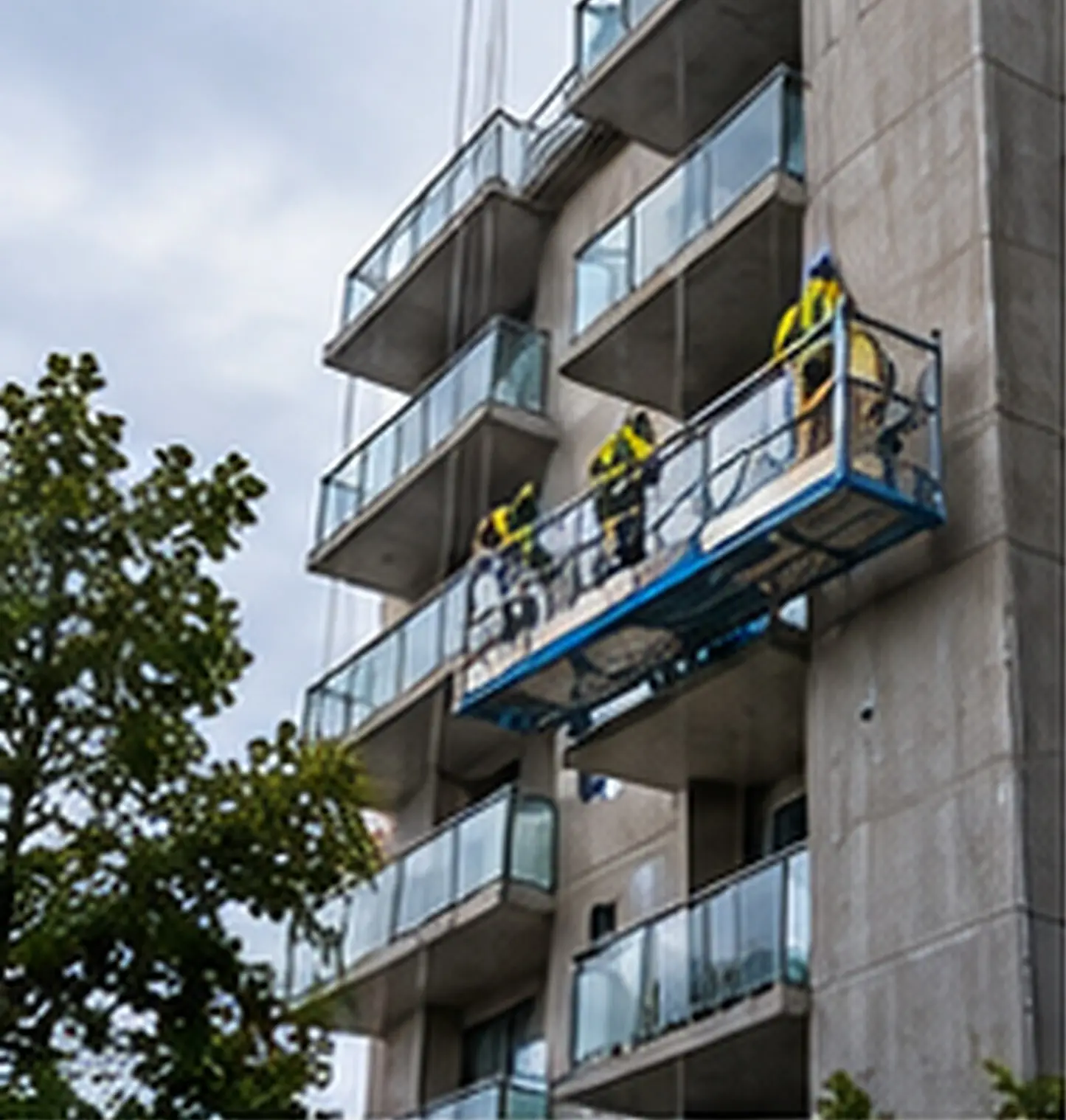
The cost of ignoring it
Facade defects carry a falling-object risk to occupants and the public. A drummy render panel or corroded lintel becomes a public-safety liability at the point of failure, and an unplanned make-safe outside working hours costs considerably more than a planned repair, without resolving the defect.
Defect mechanisms
Facades fail at interfaces: render debonding from substrate, corroding steel lintels and shelf angles cracking the masonry above, precast joints losing their seal, and fixings corroding behind cladding. Each of these conditions eventually presents a falling-object risk, so facade remediation carries a risk-management obligation alongside the building work.
Diagnostic approach
- Close-range visual survey — rope access or EWP, every elevation, defects tagged to a numbered schedule with photographs
- Drummy-area mapping by tap testing, quantified per elevation, which is what allows the scope to be priced by area
- Targeted break-outs at representative defects to confirm cause — a corroded lintel, a failed render bond and substrate cracking are three different repairs
- Fixing and anchor checks where panels or attachments are suspect
- Drone survey for whole-of-facade context and inaccessible elements, annotated against the defect schedule
Repair methodology
The scope is grouped by defect class, each with a specified system: cut-out-and-reinstate render repairs with matched finishes; lintel replacement or cathodic treatment; repointing in analysed mortar; joint reinstatement with correctly sized backer and sealant; and whole-of-elevation protective coating where carbonation or water ingress is the driver.
Access is engineered per elevation — rope access for distributed low-density defects, EWP for mid-rise reachable zones, and scaffold where repair density justifies it. The comparison is set out in the scope so that the committee can review the basis of the recommendation.
Typical building types
These defects are most commonly encountered in interwar and postwar masonry apartment buildings, rendered facades of the 1970s to 1990s, precast commercial buildings, and mixed heritage streetscapes across inner Melbourne.