The cost of ignoring it
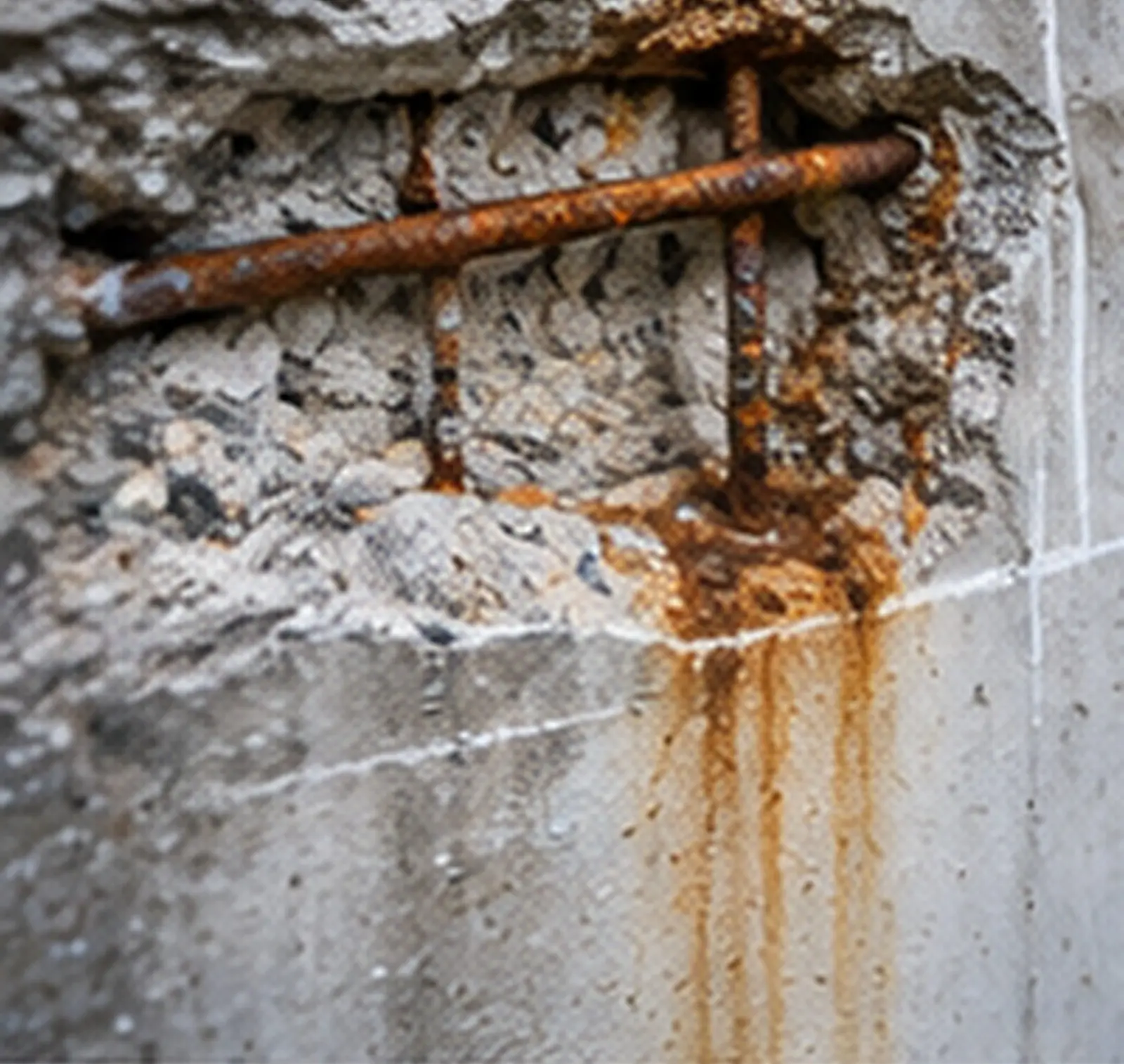
Reinforcement corrosion is progressive, and the cost of remediation rises with the extent of the damage. Cracking admits further moisture, oxygen and chlorides, which accelerates the corrosion, so a slab-edge repair that is deferred grows in extent until falling concrete becomes a safety risk and the scope requires engineering intervention.
Defect mechanism
Most concrete deterioration is corrosion of the embedded reinforcement, commonly called concrete cancer: the steel within the concrete corrodes, expands, and fractures the concrete from within. It presents as spalling, rust staining, drummy render and cracked slab edges on balconies and facades. The mechanism is progressive, because cracking admits further moisture, oxygen and chlorides, which accelerates the corrosion that produced the cracking.
Diagnostic approach
Concrete repair is not scoped from photographs. A scope developed without investigation is priced against unknowns, which produces either contingency loading or variations during the works.
Our investigation typically includes:
- Visual and hammer survey of all accessible elements, defects tagged and photographed against a numbered schedule
- Cover meter survey to map reinforcement depth and identify low-cover zones
- Carbonation depth testing (phenolphthalein) on fresh break-outs
- Chloride sampling where marine exposure or admixture history warrants it
- Half-cell potential mapping on critical elements to find active corrosion that has not yet cracked the surface
The output is a written condition report setting out the defect schedule, the cause analysis, the repair options with their respective trade-offs, and a prioritised scope.
Repair methodology
Australia has no dedicated Standard for concrete repair. The reference document is SA HB 84:2018 Guide to concrete repair and protection, developed by Standards Australia with ACRA and CSIRO — a handbook rather than a standard, and explicitly not intended as a contract document. Repair materials are typically classified and certified to the European standard EN 1504, which Australian specifiers reference by product class. Repairs follow that guidance and the technical manual for the specified system:
- Break out to sound concrete, minimum 20mm behind corroded bars, saw-cut edges, with no feather-edging
- Treat reinforcement: abrasive clean to bare steel, assess section loss (engineer referral where loss exceeds tolerance), prime with active zinc-rich or cementitious primer
- Reinstate with polymer-modified repair mortar matched to substrate strength, cured in accordance with the system data sheet
- Protect: anti-carbonation coating or penetrating inhibitor applied across the element rather than the patch alone, so that the ring-anode effect does not relocate the corrosion to the patch perimeter
Every stage is a hold point with photographic records, and those records form the evidence trail issued at handover.
Typical locations
Reinforcement corrosion is most frequently found in balcony slab edges and soffits, facade panels and window hoods, carpark slabs and columns, planter boxes, lift overruns and plant decks. It occurs wherever reinforced concrete is exposed to weather, and particularly in buildings constructed between the 1960s and 1990s with the cover tolerances of that era.