Diagnostics & technology
Investigation before specification
Every engagement begins with a written condition report: the test methods applied, the findings, and a numbered defect schedule. The repair scope is built from that evidence.
Approach
Why we investigate before pricing
Remedial work priced from a visual inspection alone is priced against unknown extent. The result is either a contingency built into the rate, or a lean price that generates variations once the work opens up. In both cases the client carries the risk.
We begin with investigation. The test methods below are selected according to the suspected mechanism and reported against a numbered defect schedule. The scope that follows is itemised against evidence the client holds and can provide to any other contractor for comparison.
The toolkit
Test methods and what they establish
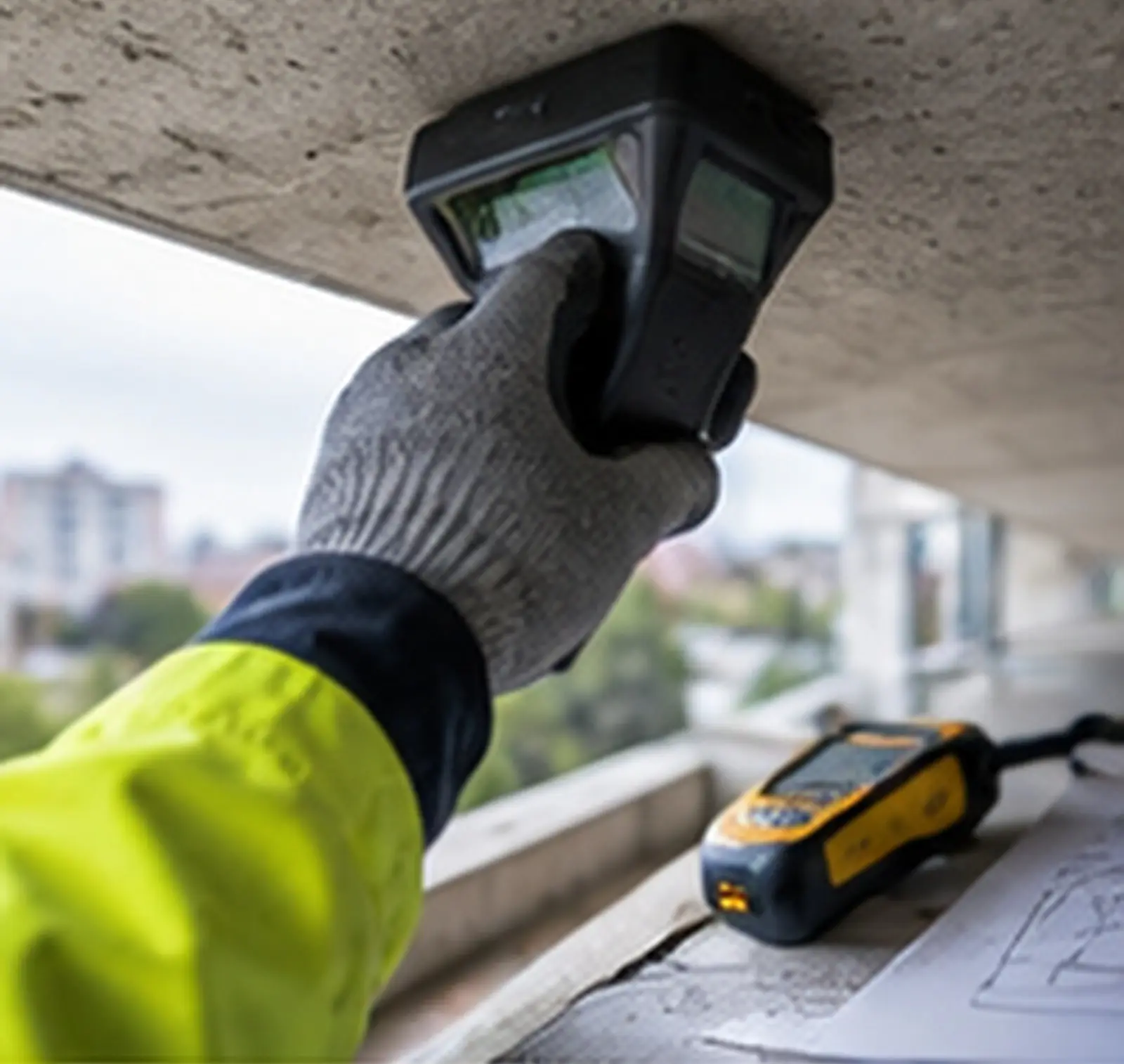
Cover meter & GPR survey
BS 1881-204
Maps reinforcement position and depth non-destructively.
APPLICATION — Cover depth is the primary determinant of corrosion risk, and reinforcement position must be established before any strengthening design.
Carbonation & chloride testing
BS EN 14630 · AS 1012.20.1
Measures how far the concrete's chemical protection has been lost, and whether chlorides have contaminated it.
APPLICATION — Determines whether patch repair can work at all, or whether the element needs protective or cathodic systems.
Half-cell potential mapping
ASTM C876
Electrochemical survey locating actively corroding reinforcement before it cracks the surface.
APPLICATION — Identifies zones requiring intervention that have not yet cracked the surface, so the scope reflects actual extent rather than visible extent.
Moisture mapping & electronic leak detection
Flood testing to AS 4654.2
Locates water and its entry points behind finishes and within membranes, without demolition.
APPLICATION — Water frequently surfaces a considerable distance from its entry point. Testing localises the breach and avoids exploratory demolition.
Drone survey & photogrammetry
CASA-licensed operation
Whole-of-facade capture, annotated against the defect schedule; inaccessible elements documented.
APPLICATION — Context for every tagged defect, a photographic baseline for future comparison, and access-free triage.
Load & anchorage testing
AS/NZS 1170.1 Table 3.3
Pull tests on balustrades, anchors and fixings against design loads.
APPLICATION — Provides a measured basis for assessing fall-protection elements against design loads, rather than a visual opinion.
The evidence trail
A traceable record from investigation to completion
Each defect is assigned a reference at investigation. That reference carries through the scope, the hold-point records and the completion report, so the completion evidence is auditable against the original schedule. This reporting standard applies to every project regardless of value.
Process
Where investigation sits in the engagement
- 01 / INVESTIGATE
Investigate
A structured condition investigation: visual survey, cover meter and moisture mapping, and targeted break-outs where the suspected mechanism warrants them. The output is a written condition report with a numbered defect schedule.
- 02 / SCOPE
Scope and price
The report becomes an itemised methodology: defect schedule, named repair systems, access strategy, programme and staged pricing. Formatted for committee approval or for review by a consulting engineer.
- 03 / REMEDIATE
Deliver
Works executed to the approved methodology, with inspection and test plans, hold points and progress photography. Variations are documented and approved before the work proceeds.
- 04 / VERIFY
Verify and hand over
A completion report with condition evidence against the original defect schedule, warranties for the systems installed, and a maintenance schedule to protect the design life of the repair.
FAQ
Diagnostics — common questions
01 What does a diagnostic assessment cost?
It varies with the building and the scope of the question: assessing a single balcony is a different exercise from a whole-of-facade survey. It is typically a low single-digit percentage of the works value it defines, quoted as a fixed fee before commencement. Where works proceed with us, the investigation cost is credited against the project.
02 Can we use your condition report to get other quotes?
Yes. The report is the client's property. A defect schedule with mapped extent is what makes competing quotes genuinely comparable, and we would rather compete on a common scope than on differing assumptions.
03 Do you do urgent make-safes without the full process?
Yes. Falling material and immediate safety risks are made safe first and investigated afterwards. The investigation process governs the permanent repair, not the emergency response.